November comes this Saturday, and with it a potential halt to food assistance.
By Scott Morgan, Managing Editor
Oct. 26,2025
Journalism is often an exercise in how to tell people things they need to know without being alarmist. So let’s start by saying this: This entire article could be negated five minutes after it’s published.
But if the federal shutdown is still happening at the end of this week, Halloween will be the last day that low-income South Carolinians can use their SNAP and WIC benefits for who knows how long. And the shutdown might also affect TANF.
Three quick definitions
- SNAP stands for Supplemental Nutrition Assistance Program. It used to be referred to as food stamps. Where you see a sign at a store that says it accepts EBT payments, it’s referring to SNAP.
Data for how many South Carolinians receive SNAP are available through May. According to USDA, which facilitates the program, 567,895 South Carolinians received SNAP benefits in May.
Data on how much they received are available through 2023. According to USDA, the average person receiving SNAP benefits in South Carolina got $203 per month; the average household, $384. - WIC stands for Women, Infants, Children. WIC is an offshoot of SNAP that “provides free, healthy foods and personalized nutrition education, breastfeeding support and referrals to other services”
South Carolina received $97 million in WIC funding in 2023. The program provided assistance for 22,766 infants that year. - TANF stands for Temporary Assistance for Needy Families. TANF is administered through the federal Department of Health and Human Services and is, according to its own website, “one of the nation’s primary economic security and stability programs for families and children with low-incomes.”
TANF serves an average of about 5,600 South Carolina families per month, about half of which are single-parent families. About 13,000 individual South Carolinians ger TANF help every month and more than 10,000 of them are children. Those data are through September, 2024.
South Carolina limits TANF recipients to two years of benefits per 10-year cycle. The maximum benefit for a family of three was $418 per month in 2022.
It is still unclear whether TANF benefits will stop on Nov. 1. U.S. Sen Tim Scott of South Carolina posted on his website that “because TANF is federally funded but state-administered, benefits may continue depending on state resources. South Carolina may be able to maintain TANF payments temporarily even if federal disbursements are delayed.”
Food assistance is available
The federal shutdown began at the start of the 2025-26 federal fiscal year, which was Oct. 1. SNAP and WIC benefits were funded in last year’s budget to operate through Oct. 31, 2025.
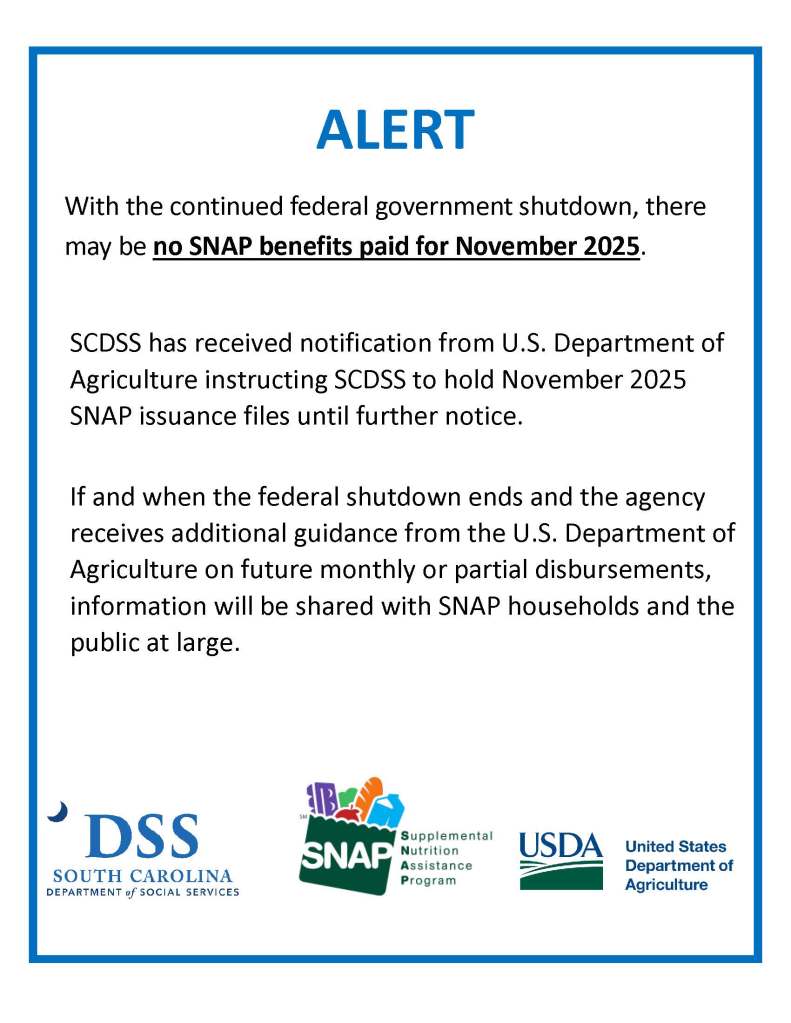
The South Carolina Department of Social Services, which administers SNAP payments to recipients in the state, issued a statement on Oct. 22. In part, it said:
With the continued federal government shutdown, there may be no SNAP benefits paid for November 2025. On October 10, 2025, SCDSS received notification from USDA instructing SCDSS to hold November 2025 SNAP issuance files until further notice. Based on recent issuance data, we understand that over 260,000 households in South Carolina rely on these benefits to supplement their family’s monthly food purchasing power. Until there is a resolution in Washington, D.C. and the federal government is funded and reopens, SCDSS will not be able to provide the federally funded benefits to new and on-going SNAP households until further notice.
DSS also urges food assistance recipients to “look to local food banks and food pantries for assistance.” The agency lists the following:
Golden Harvest Food Bank
Serves Allendale, Aiken, Bamberg, Barnwell, Edgefield, McCormick counties.
Harvest Hope Food Bank
Serves Calhoun, Chester, Chesterfield, Clarendon, Darlington, Dillon, Fairfield, Florence, Greenville, Kershaw, Laurens, Lee, Lexington, Marion, Marlboro, Newberry, Orangeburg, Richland, Saluda and Sumter counties.
Lowcountry Food Bank
Serves Beaufort, Berkeley, Charleston, Colleton, Dorchester, Georgetown, Hampton, Horry, Jasper, and Williamsburg counties.
Second Harvest Food Bank of Metrolina
Serves Abbeville, Anderson, Cherokee, Greenwood, Lancaster, Oconee, Pickens, Spartanburg, Union, and York counties.
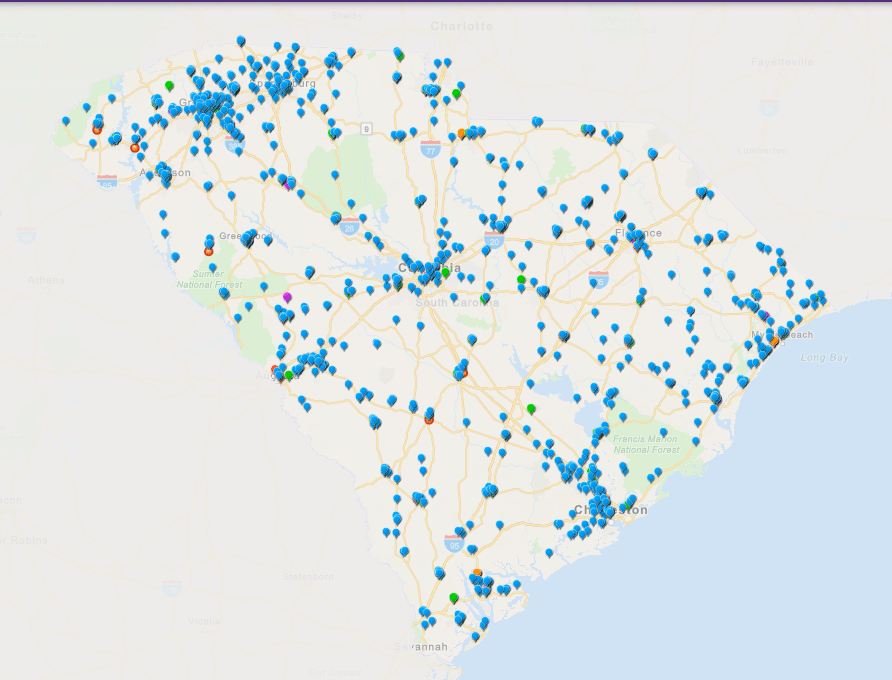
This map also lays out food banks in the state.
Food banks are strained and may be out of reach
While food banks all over South Carolina say they will continue providing what they can, their outlook at the moment is dire.
On its Facebook page, Harvest Hope, the state’s largest food bank, posted a nearly universal theme among food banks in the Carolinas: “Our shelves are running critically low. Families are turning to Harvest Hope amidst the government shutdown and we can’t meet demand without additional funding.”
Even if food banks were fully prepared to meet the needs of every visitor (they are not), they’re not easily accessible to everyone. For anyone living in city centers like Rock Hill, Lancaster, Chester, York, or Gaffney, there are several food bank options nearby.
But for those living in rural areas, any disruption to SNAP benefits could become especially problematic. SNAP recipients in towns such as Sharon (York County) or Chesnee (Cherokee/Spartanburg counties) or Chesterfield live between 15 and 50 miles from the nearest food bank. And none of these areas has public transit options to get residents to one.
And if an option to get food or groceries delivered is Amazon or Uber or DoorDash, consider that delivery would come mainly from dollar stores and that the cost of delivery is escalating, for packages that often cost upwards of $30 per meal.

 the Oasis
Leave a comment