
Affordable housing conferences do a good job of defining the problem. They need to start doing a better job of showing the process of solutions.
By Scott Morgan, Managing Editor
Nov. 8, 2025
Housing conferences have a lot of numbers, but not much plot. Like a phone book. Which used to exist, I promise.
The trouble is, numbers can be misrepresentative. Someone at nearly every affordable housing conference will cite the state’s minimum wage ($7.25 an hour) and compare it to the living wage for a single adult with no children ($22.15 an hour ) as a major factor behind housing instability.
But while roughly 1 in 5 workers in South Carolina do make $15 an hour or less, very few adults work in jobs that pay minimum wage. South Carolina’s lowest-earning county is McCormick, where first-quarter weekly wages in 2025 averaged $821 — about $20 an hour.
None of which is to suggest that South Carolina is affordable for everyone.
But housing insecurity has a lot of moving parts, and numbers are just part of the picture. Something the press is (rightly) criticized over is zeroing in on the most extreme possible scenario as if it represents holistic reality.
So please believe me when I say, tread lightly. Spouting doomsday numbers is an easy way to alienate people and a lousy way to address real solutions to a vast and complicated issue.
So what’s being done?
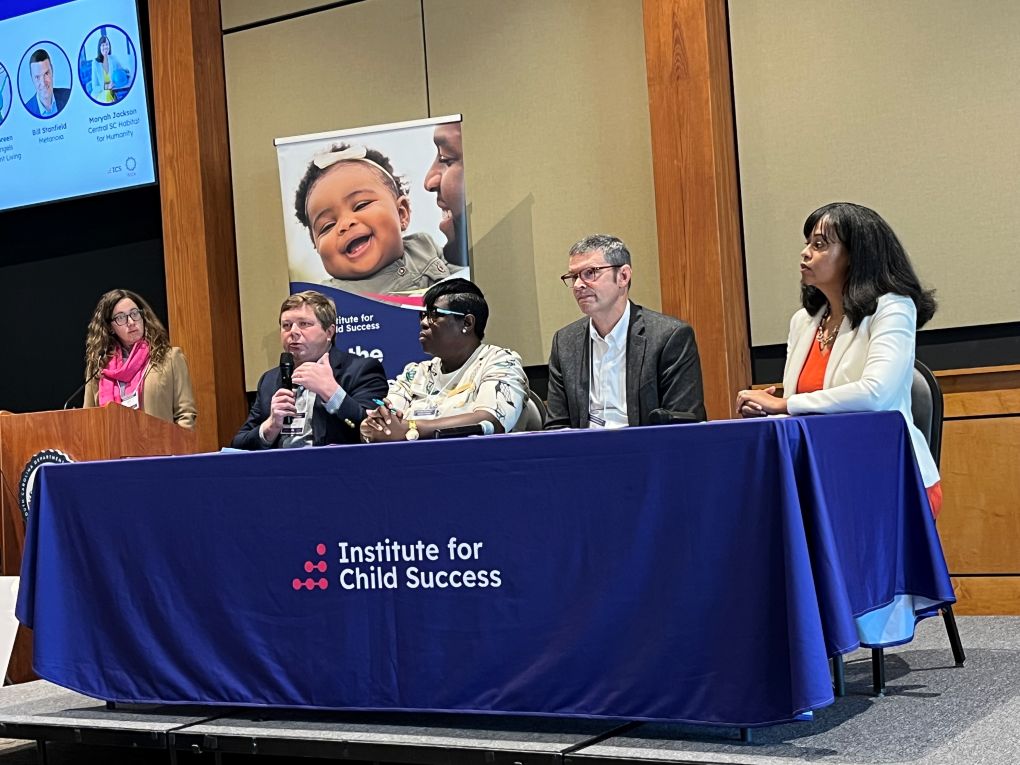
On Nov. 7, I attended the Institute for Child Success’ Housing Innovation summit in West Columbia.
Out of the gate, Joey Current, director of statewide impact and innovation at Trident United Way, in North Charleston, laid out the need to talk about answers in a more substantive way.
“I heard a quote from former President Barack Obama one time that said that we’re getting really good at finding sophisticated ways to describe the problem,” Current said. “And we’ve been talking about this and having this conversation for years and years and years. And so what’s really important is that we figure out, what are we going to do about it and what are the most innovative approaches?”
There are some interesting approaches around the state that were brought up at the summit. The Village at Fairfield, for example, which involved money from the Fairfield Education Foundation and land from the county school district, to build housing specifically for teachers.
Metanoia, a nonprofit community development organization in North Charleston, is land banking as a way to ensure that housing stays in the attainable realm amid growing gentrification.
But the summit mostly laid bare that the ecosystem of housing insecurity is enormous, full of obstacles, and short on a unifying approach to solutions.
Some of the obstacles are hard to overcome — the fact that building a new house, on average, costs about $160 per square foot (i.e., $160,000 to build a 1,000-square-foot house), for instance. That’s just building the house –and the costs of labor and supplies are not likely to come down.
SC Housing is trying to address this through its Made It Home! program, which, in a broad sense, subsidizes construction costs to ensure builders get paid and buyers get more affordable options. The program had to be recalibrated, though, because it originally was too cumbersome and not enough to incentivize builders.
Other obstacles, like NIMBYism, local egos, restrictive zoning laws, lack of political will, and the silos housing affordability advocates work in are less tangible, but no less daunting. And while housing conferences do a good (seriously) job of bringing all those things out, they do a lousy job of giving advocates anything to actually do.
So ….
We need blueprints
Summits like the one on Nov. 7 do bring voices together and do outline the scope of the problem. And while conversation and connection are vital, the conversations need to start being more blueprint than whitepaper.
Yes, we need to know the numbers. Yes, we need to have the conversations. Yes, we need to tell each other what we’re doing in our own corners of South Carolina to address housing insecurity and affordability.
But we don’t need abstract statistics and misleading arguments. We don’t need to keep agreeing that the ecosystem of housing insecurity is multifaceted and unwieldy. We don’t need to hear overviews of ideas that might work, kinda work, or could work if.
We need to know how to replicate the wins. We need blueprints. How did the City of Laurens design and craft its housing pattern book to cut down huge amounts of time and red tape that builders end up getting tangled in? How did Fairfield County Foundation go, step-by-step through the process of working with school officials to build a village for teachers? How did Grace Church buy and convert a college building in Greenville to affordable housing?
The how is the missing step in these conversations. The what and the where, the complexity of the interrelationships between wages and debt and public health and transportation and poor housing are already part of these conversations, and they need to continue to be — especially to policymakers who might not know how things like eviction filings, cockroaches, and prohibitive medical debt are all part of the same story.
But if we want to substantively address a massive, interconnected, universal issue like housing insecurity, we need to know the recipes this state’s multitude of lawmakers, builders, nonprofits, cooperatives, and coalitions follow, how they can be adapted broadly, and how they can be implemented.
There are lots of innovative ideas out there. Let’s not just talk about why they’re important, let’s start talking about how to follow their blueprints.
Like The Oasis? Want to keep up with real conversations about housing, food insecurity, transportation insecurity, and new ideas to address these kinds of issues in South Carolina? Start by subscribing to this page. Just scroll down and add your email to our growing list.



 the Oasis
Leave a comment