
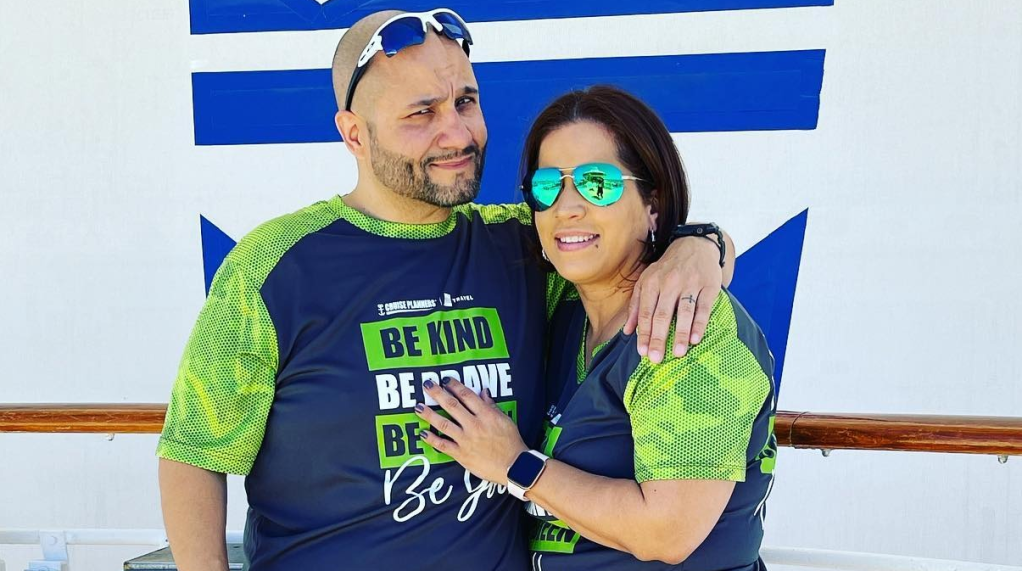
Juan Velazquez was born and raised in New Jersey. He now lives in Fort Mill, South Carolina. He went to Canada and ended up facing a masked immigration agent, a German shepherd, and the fear of being disappeared, when he came back.
By Scott Morgan, Managing Editor
Nov. 21, 2025
Parked cars. That’s what scares Juan Velazquez most. Parked cars with tinted windows. SUVs in parking lots.
He wonders: Is this them? Is this someone coming to take him away? To take his wife?
Or maybe it’s a strange number, calling to talk to him about his story that scares him the most. Maybe it’s ‘them,’ trying to lure him into a trap.
Or maybe it’s the fear of being disappeared; of being taken off the streets and sent somewhere, to be detained, to be flown somewhere far away because he can’t convince them that he belongs here.
And here’s where it’s important to note: Juan Velazquez is American — born 49 years ago this week in Newark, New Jersey. He now lives with his wife, Evelisa, in Fort Mill. Evelisa is also American, born and raised in Puerto Rico, a U.S. territory. They have a son in school in Florida, who wants to score music for films.
He’s afraid something could happen to all three of them.
Quebec
Velazquez didn’t used to have a fear of tinted windows, phone calls, or being seen in public. Not like he does now. That all ramped up in October, when Velazquez — who’s job is facilitating travel — went to Quebec.
“We got off the plane and went through border enforcement,” Velazquez says.
Nothing unusual, he says. But they were taking American passengers to a different line than everyone else.
He jokes: “Maybe it’s because there’s this mass exodus of Americans.”
Velazquez found himself led to an interview room with officials who were “Canadian nice.” They asked him his purpose in Canada — business: he was doing a product review and taking photographs for a company — and the various questions border agents ask travelers. Velazquez, the only American Latino on the flight, thought little of the encounter until he started speaking with other Americans who’d flown with him.
“None of them were put into this room,” he says. “I thought, maybe it’s just a coincidence.”
He held that thought until the ship he boarded in Quebec pulled into port in Maine.
‘This one’s mine’
ICE, Immigration and Customs Enforcement, usually isn’t present on ships. Ships are typically the domain of Customs and Border Patrol and the U.S. Coast Guard.
But when Velazquez met a masked agent on the ship, it was an ICE agent, “a big, intimidating man,” who towered above Velazquez’s 5-foot-4 frame.
“When they got to me,” he says, “they asked intrusive questions. Personal questions.”
He only offered his passport. He says the ICE agent told his colleagues, “This one’s a hostile one,” and led Velazquez off to another room, where he was questioned by other agents.
“I answered questions,” he says. “And the ICE agent comes over, he closes the laptop, and says ‘No, no, this one’s mine.’”
The agent grilled him about where he was from.
“He just wanted to hear the words, ‘I was born in dot-dot-dot.” he says.
And Velazquez didn’t feel he should have to tell him. He’d already offered his U.S. passport. But, he says, “I felt compelled to comply.” It had landed on him that if he didn’t start providing answers, it could cost him however many days or weeks or months of his life and thousands of dollars in legal bills.
“They had an agenda of their own,” he says. “They so badly wanted to find a reason to detain me permanently.”
It ended up being about 90 minutes before the agents cleared Velazquez to go back to work.
He instead went out for a bourbon to calm his nerves.
‘Here we go again’
When the ship Velazquez was on docked in Miami days later, the story of his run-ins with immigration agents played itself out again — three lines, border enforcement, and an intimidating man in a uniform to greet him.
“It wasn’t a minute before another big fellow came up to me,” he says.
This agent appeared to be of Latino descent as well. He spoke to Velazquez in Spanish, and when Velazquez replied in kind, the man said, “Ven conmigo.”
Come with me.
Another giant room. But this time, no questions. This time, the agents took off Valazquez’s sweater and hat; cuffed him to a railing; rifled through (and broke) his camera equipment while looking for drugs they’d suspected would be hidden inside.
They told him the cuffing was for his own protection. And then, he says, they left him, with “a massive German shepherd right in my face, unattended.”
His clothes scattered, his lens broken, the agents let him go. One agent, a woman, came over to help him gather his things.
“I thought, this has got to be a joke,” he says. “I felt like I was in a bad dream. Like, here we go again. But then I thought, Man, this is real!”
Worse, he started thinking of how this kind of thing could happen to his son in Florida. Velazquez visited his son and collected his thoughts and just wanted to get home. So he went to get on a plane.
‘We’re gonna want to download your information’
Juan Velazquez has TSA PreCheck.
According to the Transportation Safety Administration, “TSA PreCheck gives trusted travelers a speedier security experience in dedicated lanes across the U.S.”
Meaning: Juan Velazquez should have walked into Miami international Airport and sailed swiftly through his check-in line. Instead, he says, TSA agents had him remove his shoes — “With TSA PreCheck leave in your bag electronics and 3-1-1 liquids and leave on belts, light jackets, and shoes,” the TSA website states — while they asked him for his phone.
“They said, ‘We’re gonna want to download your information [from this phone],’” Velaquez says.
His text messages, his contacts, his photos, everything. He could either comply or make things difficult for himself; possibly miss his flight.
“I said, ‘I guess I’m gonna have to make this harder on myself,’” he says. He refused to let them download information from his phone.
About a half-hour later, the “good cop,” speaking to Valazquez in Spanish, showed up to try to convince him to play along, Velazquez says. He didn’t. And, finally, he was allowed to get on a plane to fly home.
The after-effects: ‘It doesn’t matter if you’re a U.S. citizen’
For most of this past week, immigration agents and officers under the auspices of the U.S. Department of Homeland Security (DHS) turned their law enforcement attentions on Charlotte, barely 16 miles north of Fort Mill.
DHS touted Operation Charlotte’s Web as a success, claiming more than 250 arrests.
Broadly, though, city businesses took a major hit from the crackdown, as residents have avoided going out in public, to stores and even school.
Back across the border in York County, life for Juan and Evelisa Velazquez, and for their friends, has darkened.
“I have friends who are afraid to go to the grocery store,” he says. The crew who clean his apartment complex didn’t come back to work days after Operation Charlotte’s Web commenced.
Another friend told him that he couldn’t go to church anymore because he was too afraid that something might happen.
Velazquez is not comfortable being seen in public either. And his own business has felt the pressure too.
“I do a lot of business in Charlotte,” Velazquez says. But now, when a strange number calls, he’s not sure he always wants to answer. He confesses that if someone hadn’t vouched for me, Velazquez wouldn’t have said yes to someone he didn’t know, who’d said he was a reporter.
“I’m wary of requests now,” he says. “I’m screening clients. We’ve gotten to the point where we’re afraid to take anyone at their word.”
Fear has sunk deep into Juan Velazquez’s bones. Shortly after Operation Charlotte’s Web began, a friend in Charlotte asked the Velazquezes to come over for a fire pit.
“I had to text him that I’m afraid,” he says.
In town, the parked black cars with the darkened-out windows terrify him.
“I saw this vehicle in town and I thought, ‘Is this them?’” he says. “It wasn’t, it was someone with their little daughter, but I was thinking, what do I do? Do I start running? I panicked, thinking this could be ‘them.’”
Evelisa had a near identical reaction to a black SUV that had pulled into a lot near her, he says. Panic. The urge to run and hide, in her own country.
“I fear that someone might see us and do something to us,” he says. “Just this fear of being disappeared.”
Federal immigration officials have stated that U.S. citizens have nothing to worry about, that immigration raids, or enforcement actions, are only targeting “illegal” or violent foreign-born criminals.
In October, the same month Velazquez went through his four-pronged ordeal, ProPublica reported that DHS spokesperson Tricia McLaughlin said that U.S. immigration enforcement agents “do not racially profile or target Americans.”
Juan Velazquez isn’t convinced anymore. He identifies himself as “more red. white, and blue than anybody.” A Latino, “an individual who is American,” and a person with Taino roots, indigenous to the Caribbean. He was raised by “a hardcore Republican” father who, at 80 years old, is a Vietnam veteran questioning where his party is, Velazquez says.
He’s worried about the growing number of stories of U.S. citizens being taken into custody by immigration agents, like in Virginia, New York, and California.
He says of himself and his wife, “We’re terrified that it doesn’t matter if you’re a U.S. citizen.”
More than No Kings rallies
Velazquez says he hopes more people in his community speak out about the realities immigrant residents are facing. Moreover, he hopes political leaders in South Carolina take a more public stand against the kinds of intimidation he says he felt on his business trip.
“I love the No Kings rallies,” he says. “But we need to do so much more.”
He says people can start by understanding the difference between immigration law enforcement and what’s happening now.
“What’s occurring here in the U.S. is no longer an immigration issue,” he says. “This is targeted enforcement.”
Mainly, he says, of people who look like him or have Latino names.
The fear and anger and doubt he feels have cast a shadow over his home too.
“I love where I live,” he says. “At least I thought I did.”
Like the Oasis? Want to stay up with stories about your neighbors in South Carolina? Start by subscribing to our newsletter. It’s easy. Just scroll down and enter your email address, and get notified when new stories are published.

 the Oasis
Leave a comment