
Live Healthy Cherokee is an ambitious initiative years in the making. It will be years of work, too.
By Scott Morgan, Managing Editor
Jan. 31, 2026
Something in the neighborhood of 50 people filter in from a cold January morning in Gaffney. The day can’t make up its mind whether it wants to be cold and damp or cold and rainy.
The day opts for both.
None of the people inside appear to care. This is a momentous day for them. Today is the day almost two decades of work come together with intent – to make Cherokee County healthy.
Not again. Because it never has been.
This particularly indecisive morning marks the formal launch of Live Healthy Cherokee, or LHC, a “community health improvement plan” that is the latest iteration of initiatives in the county that date back to 2009.
The model for this initiative is Live Health Spartanburg, in that it zeroes in on what people eat, what kinds of access to care they have, and what kinds of opportunities their children will have in order to succeed later in life.
The goal is an ambitious one, given the scope of factors – housing quality, food availability, access to hospitals, rates of health insurance, etc. – that go into figuring out how healthy, or not, a place is.
So a comparison is in order.
Cherokee County borders three counties …
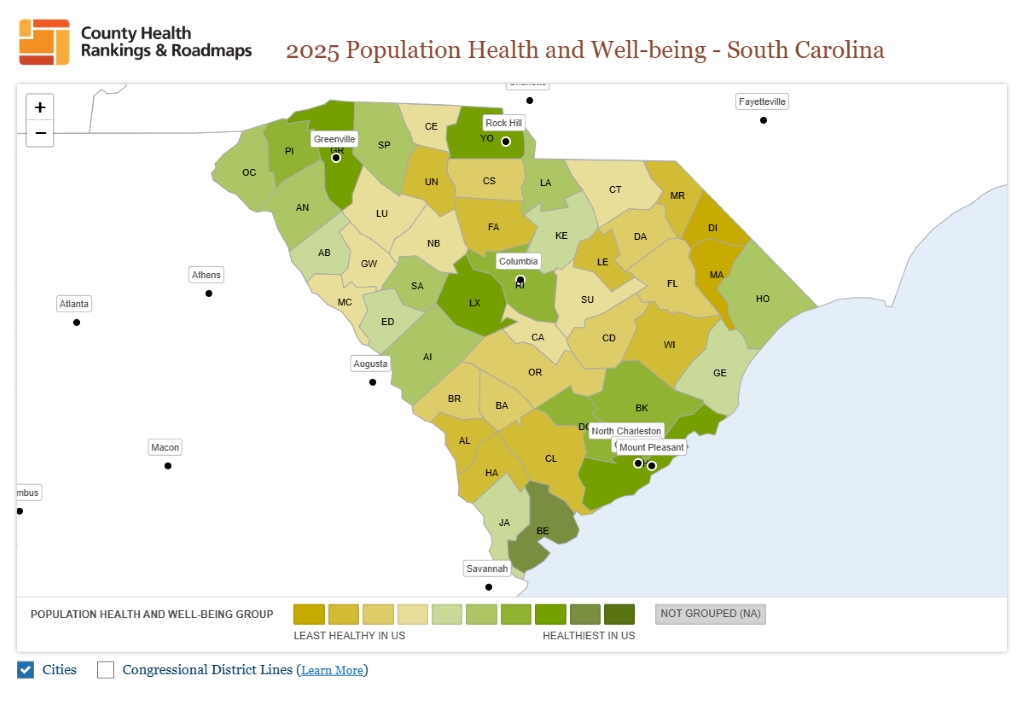
Cherokee County is sandwiched between two of South Carolina’s most populated, wealthy, and healthy counties, Spartanburg and York.
It also sits atop one of the state’s least populated, poorest, and least healthy counties, Union.
Of the three, Cherokee has more in common with Union than with the other two, in regards to health.
Overall health rankings
The University of Wisconsin Population Health Institute annually puts out its County Health Rankings & Roadmaps report. The report draws its conclusions from a broad suite of data points, from healthy days per year to flu vaccination rates.
According to its 2025 report, York County is among the healthiest in the United States. Tellingly, York has one of most robust health infrastructure setups in the state, with higher vaccination rates, fewer severe housing problems, and better air quality than the state and country overall.
Spartanburg County is about as healthy as the United States, averaged out, but ranks markedly higher on the health scale than South Carolina overall (which is considered to be on the bottom-tier among states for health).
Union County, by contrast, is among the least healthy in the United States. It has far higher rates of premature death, more sick days per year, higher rates of low birth weight, and a higher average number of poor mental health days than the state and country.
Cherokee falls between Spartanburg and Union counties on these rankings – noticeably less healthy than the country, and not far off state numbers for overall health and well-being.
However, Cherokee County does exceed state rates on access to mental healthcare providers and dentists, and has higher rates of mammography screenings than the state and country overall.
Cherokee County residents also have better access to healthy food than state and national averages.
Partly, this is due to a concentrated effort to put healthy food – and, critically, information on how to prepare and cook it – in front of Cherokee County residents.
Teresa Spires is the executive director of Know(2), a nonprofit social services organization based in Gaffney that aims to turn health disparities around. Spires also is a major player in LHC and she runs the county’s FoodShare program.
Her perspective is an uncomplicated one: “ Our biggest issue is getting healthy food into people’s homes.”
How, though?
While Cherokee County ranks well for access to healthy foods, that does not necessarily mean residents are eating it.
Spires is candid and direct in a way reserved for only those who’ve spent their careers frustrated by the viscous, sticky way social problems like hunger and transportation linger for people without means.
Food access, she says, is partly “a transportation issue, some of it’s an education issue.”
Over the next three years, Spires says, the work of the LHC initiative should help lessen the food insecurity issue in the county. But as much as she is frank, she is pragmatic.
“I don’t know if we can fix the transportation issue,” she says, “although I have plans to create a mobile market and take food to where people are.”
A mobile market in Cherokee County is an ambitious but difficult task. About a quarter of Cherokee County’s population (57,770 overall, according to the U.S. Census) lives in Gaffney and Blacksburg, where doctors, food stores, thrift shops, and food pantries are concentrated.
Traversing a mostly rural county to bring food to people who can’t easily get to it, though, Spires admits, is a hefty task.
A little more than 5.4% of households in Cherokee County have no vehicle, according to Census data. That’s a hair better than the 5.7% of households in South Carolina overall that have no vehicle at home.
For comparison, zero-vehicle rates by county are: Spartanburg (1.8%) and York County (2.1%). Data were not available for Union County.
Getting food to people is, of course, only part of the problem. Some people, Spires says, aren’t sure what to do with some foods even if they have them.
“Educating people about what they can eat and what they should eat, and doing it in a way that is enticing so that they actually will do it” is the goal, she says.
Know(2) tries to help people figure out what to do with fruits and vegetables with which they might not be so familiar.
“If there’s something like mangoes that you have to have special knowledge of,” Spires says, “or pineapples where you have to know how to cut it, I try to make sure that there’s a QR code or there’s instructions on how do you use this, to make it easier for people to figure out.”
Remember, this can be more challenging than it might seem. Food insecurity rates in Cherokee County are the third-highest in the Upstate. According to the South Carolina Department of Health (DPH), 11.8% of residents in Cherokee County were food insecure in the department’s 2021 study. Only the counties of Union (14.1%) and Laurens (12.2%) had higher rates.
More telling, DPH data show that more than half of adults in Cherokee County do not eat fruit on a daily basis and a third do not eat vegetables daily.
More recent numbers by Feeding America show that hunger has gotten worse. By 2023, 16.1% of residents of Cherokee County were considered food insecure. That makes Cherokee the county with the second-highest rate of food insecurity in the Upstate, behind Union (18.5%).
Other health factors, by comparison
DPH charts life expectancy by Census tract in South Carolina. Depending on which tract someone lives in can mean a huge difference in how many years one could expect to live.
In Cherokee County, life expectancy overall averaged just over 74 years in DPH’s measure. Around Gaffney, life expectancy was 71.4 years, and in the Blacksburg area it was almost 73 years.
Meanwhile in the smaller towns to the west and north of Gaffney, like Thicketty and Macedonia, life expectancy was between 77 and 79 years.
Life expectancy in Spartanburg County had a much wider range, according to DPH – between 85 years in the smaller towns like Roebuck and Pauline and 68 years closer to the City of Spartanburg.
York County had a similar range in life expectancy. In and around the smaller towns of Tega Cay and Fort Mill, life expectancy was 84.6 years, while closer to the center of Rock Hill, it was a full 17 years fewer.
Life expectancy in Union County had the narrowest range, between 70 and 76 years.
The areas with lower life expectancy coincide with areas that have lower levels median wealth, lower housing and property values, and higher rates of non-white residents.
And while neither Live Healthy Cherokee nor Live Health Spartanburg focus on vaccination rates, it is worth mentioning that South Carolina’s measles outbreak is concentrated in the counties that have among the lowest rates of MMR vaccination in South Carolina.
At the end of January, DPH reported 813 cases of measles in Spartanburg County, where 89% of students are vaccinated, the state’s lowest rate; 28 cases in Greenville County, where 92% of students are vaccinated; 5 cases in Anderson County, where 94% of students are vaccinated; and fewer than five cases in Cherokee County, where 93% of students are vaccinated.
No cases were reported in York or Union counties, where 93.7% and 96.4% of students, respectively, are vaccinated.
Live Healthy Cherokee
Over the next three years, LHC has the stated goal of getting more residents of Cherokee County better access to food, healthcare, recreation, exercise, and learning opportunities.
“There are four different priority areas,” said Libbie Cheek, one of the main architects of LHC, at the launch breakfast earlier this month. “First being access to care.”
Second is access to behavioral healthcare. Mental Health America charts risk factors and rates of mental and behavioral health disorders. South Carolina factors among the most mentally healthy states, but within the state, Spartanburg ranks among counties with the highest rates of depression (almost 34 cases per 100,000 residents).
Cherokee and York counties have lower rates of depression; Union County, with fewer than 28 cases per 100,000 residents, is on the low end in the Upstate.
Nuance: According to the County Health Rankings report, there are far fewer mental healthcare providers per capita in counties like Cherokee and Union than in the state overall. That also holds true, however, for Spartanburg.
LHC is also focusing on chronic disease (where food factors in) and child/family resilience.
According to DPH, rates of chronic disease in Cherokee and its border counties progress in level of severity from York to Spartanburg to Cherokee to Union.
So LHC has high goals, but they will be tough to reach, Cheek said.
”Figuring out how we’re gonna know when we have done good and made a difference,” she said, will be hard to measure. But she wants to start with the measurable numbers.
“We’re gonna see the number of our people who have a health insurance go up,” she said. “We’re also gonna increase the number of providers that we have per resident here in our community. That is probably gonna be a whole lot of work.”
Complicating matters, Cheek said, is the pace of residential growth. According to the Federal Reserve, the number of housing permits issued in Cherokee County since 2020 has hovered at or above the 200 mark per year – notably higher than a decade ago. Census data also show more than 1,500 more residents of the county in 2024 than in 2020.
“If you live here in Gaffney,” Cheek said, “you know that there’s houses and townhouses and big homes and projects being built every day,” Cheek said. “So while we do have a lower number of providers per resident than we should, we’re really about to make that be even a lesser number.
In 2025, according to the County Health Rankings report, Cherokee County had one primary care physician for every 3,300 residents. In South Carolina overall, the ratio was one to 1,480.
Cheek also wants to see a decrease in avoidable emergency room visits and “quicker response to prenatal care,” getting the care earlier, and having more adequate prenatal care.
“That’s another big issue that we face here in our community,” she said.
A 2024 report by DPH found that Cherokee County had among the highest risk of maternal vulnerability in the state.
With the task ahead to improve Cherokee County’s health outcomes, Cheek is as hopeful and as pragmatic as Teresa Spires.
“None of this is gonna be easy,” she said. “It’s not gonna happen overnight. It’s certainly not gonna be just one entity fixing any of these things. It’s gonna take everyone in this room working together.”
Our work at The Oasis relies on your support. Please consider helping us continue to tell compassionate, nuanced stories and foster real journalism. Click HERE to show your support. thank you!
If you or someone you know needs to connect with support services in York or Lancaster County, please see our Resources page. We will be adding to the counties served as we grow.
Like what we do and want to keep apprised of our stories and updates? Scroll down and add your name yo our mailing list!


 the Oasis
Leave a comment