
House Bill 4270 would seal eviction records after 5 years. And even the landlords like it.
By Scott Morgan, Managing Editor
Feb. 10, 2026
In South Carolina’s housing circles, one of the surest ways to get your heart broken is to believe that a good idea will get through the legislative process.
And yet, somehow, I’m hopeful about South Carolina House Bill 4270 – the one with 18 co-sponsors (where once there were 10) across the aisle; the one that landlords and real estate agents and housing advocates actually like; the one that makes so much sense, it’s hard to believe anyone could be against it.
H-4270, at its heart, would seal eviction records – effectively removing them from the Public Index – after five years.
Right now, if you have ever had an eviction order filed against you in South Carolina –,ever – it is almost certainly still listed on the Public Index. This is where landlords go to look up your rental history, and eviction history never leaves the Public Index.
Even if the eviction never happened, the very fact that an eviction filing has been levied against you stays on your permanent record as a tenant. In practical terms of severe consequence, thousands of South Carolinians have been denied newer, better, safer places to live because of eviction records that follow them around for decades.
H-4270 would change that. It would still give landlords the ability to screen applicants and it would still let landlords see a record of eviction filings for up to five years. But then, in the same way a bankruptcy falls off your financial records; the same way a criminal charge leaves after time and gives you a chance to start again, H-4270 would give renters who made a mistake or who had the misfortune of renting from an impersonal corporation or a vindictive mom-and-pop to start again and find safer, cleaner, healthier places to live.
Why South Carolina’s eviction process is problematic
For context: It is ridiculously easy – and inexpensive – to file an eviction proceeding in South Carolina. It costs a landlord $40 to do so, and usually is done as a way of compelling late-on-their-rent tenants to pay up. It’s especially prevalent among landlords that hold title to a lot of properties (like corporations), for which $40 filings are a routine cost of business akin to shrinkage in retail.
For some corporations in the rental business, tenants can only pay through online portals that offer no forgiveness for paying even a few hours late. A lot of these setups trigger an automatic filing for eviction at midnight on the day after the rent is due.
For further context: Landlords generally don’t like to evict. It’s a costly and ineffective means of owning property for profit. But remember, you don’t have to see an eviction through to have it affect a tenant for years. You just have to file it, and for a lot of tenants, being threatened with an eviction is enough to compel them to pay their rent and stay where they are.
And although the data are a few years old, Eviction Lab paints an exceedingly unflattering portrait of South Carolina – which leads the country in evictions in almost every way. Current data from the lab’s Eviction Tracker chart evictions in two South Carolina cities, Greenville and Charleston. They rank Nos. 2 and 3, respectively, for rate of eviction in the United States.
Predators use the eviction system skillfully
On Feb. 10, a House subcommittee unanimously voted to send H-4270 to a full House committee. It doesn’t mean that the bill has become law. It means that it has cleared its first hurdle, getting out of subcommittee.
At this hearing, almost a dozen people, most representing a nonprofit or trade group, spoke about why H-4270 is so needed.
One speaker who haunts me is Dr. Vaness Dunn Guyton, CEO of Columbia-based Hush No More. The organization serves victims of domestic violence and trafficking. During her testimony to the subcommittee, Guyton said this:
“ I wanted to make sure that I gave a voice to victims. In the work that we do, we see that traffickers use evictions as a way for bondage. You can’t get past it.”
Abusers use eviction by dangling the realities of having an eviction filing on someone’s record, Guyton said.
“I have had clients that want to heal, trying to get to the next level, but they can’t because of the eviction,” she said. “It’s hard to leave an abuser if you have an eviction on your record.”
And as they usually are, children get churned up in the problems that flawed systems create.
Deborah DePaoli, Palmetto Engagement and Policy Director for the Institute for Child Success in Columbia, said at the hearing that eviction “is not an isolated event, and the impacts on children are absolutely devastating. We know that housing and housing stability is one of the greatest predictors of success for children when we’re looking at their health, health outcomes, educational outcomes, even things like engagement with criminal justice.”
The hope and the fear
The reason I’m afraid H-4270 will sere on the vine of the full South Carolina State Legislature is because it’s too important not to pass and too easily ground up in a Statehouse that’s usually more focused on business enhancements and culture war legislation than it is in ground-level social safety nets.
But I’m also hopeful about this bill, mostly because of the broad support it has. H-4270’s lead sponsor is Horry County Republican House Rep, Carla Schuessler, who also happens to be the former CEO of that county’s Habitat for Humanity chapter. She took up the bill after being approached by Appleseed Legal Justice Center in Columbia.
“ We started talking about some of the things that we were finding with housing and the housing crisis that many South Carolinians are facing today,” Schuessler said at the hearing. “We were finding that eviction filings, whether they are pursued or settled, as well as writs of expulsion, do not come off the Public Index.”
From those early conversations came talks with housing advocacy groups like Entrusted Foundation of Greer and the South Carolina Tenants Union in Charleston.
But talks also involved organizations that support rental business, like The South Carolina Association of Realtors and the South Carolina Apartment Association.
And after talks with all these groups – and a tour by the Joint Citizens and Legislative Committee on Children, a legislator-led series of listening sessions during which Lexington County Republican House Rep. Paula Calhoon said the subject of eviction and housing came up frequently among residents around the state – state legislators found they had the support of all these agencies.
In fact, representatives from all mentioned above spoke in support of H-4270 on Feb. 10.
“ From our perspective, five years is a reasonable timeframe” to remove an eviction record, said Lindsay Hutto on behalf of the South Carolina Association of Realtors, at the hearing. “After that point, eviction records, especially those that were settled or dismissed or paid in full, are no longer a reliable indicator of any current risk.”
Hutto went on to say that keeping eviction records “publicly indexed indefinitely does not provide housing providers with the decision making that they need. It could perpetuate the cycle of blocking people from attaining stable housing.”
For housing providers,” she said, “this language would improve the quality of the information that they rely on while also supporting a fairer and more functional market for all.”
What can be done?
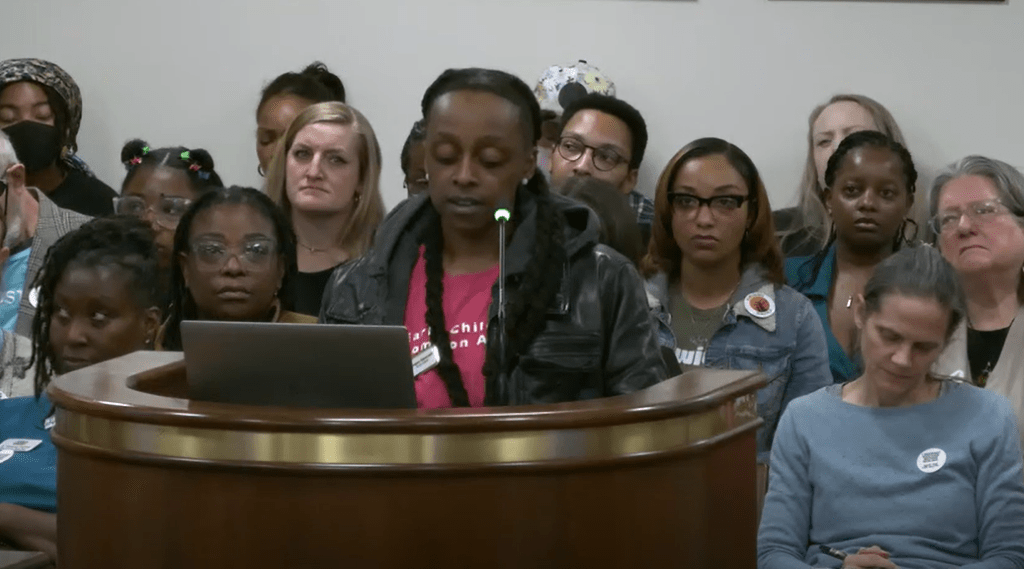
There is one other person who spoke at the hearing who haunts me: Megan Ravenel, who represented the South Carolina Early Childhood Common Agenda.
Ravenel told a depressingly familiar story of her own eviction and homelessness. What stood out so much, though, was how hard she tried to get people to listen.
“ I’ve actually been on the news,” Ravenel said.. “Me and a lot of the other tenants. Nothing happened. We [said] make it something that everybody knows about. Something that wasn’t swept under the rug, but there was no help, there was no assistance. We just voice our feelings and we keep it going. Keep paying these bills, keep rebuilding ourselves. Finding another slumlord and another slumlord.”
So yes, I’m afraid for people like Megan Ravenel and countless others who don’t bother to talk out loud to the world anymore because nothing gets done.
If only there was a way for anyone reading this editorial to contact their State House Representative and State Senator and tell them to get behind H-4270.
Oh, right. There is. CLICK HERE.
______________________________________________________________________________
Our work at The Oasis relies on your support. Please consider helping us continue to tell compassionate, nuanced stories and foster real journalism. Click HERE to show your support. Thank you!
If you or someone you know needs to connect with support services in York or Lancaster County, please see our Resources page. We will be adding to the counties served as we grow.
Like what we do and want to keep apprised of our stories and updates? Scroll down and add your name to our mailing list!

 the Oasis
Leave a comment