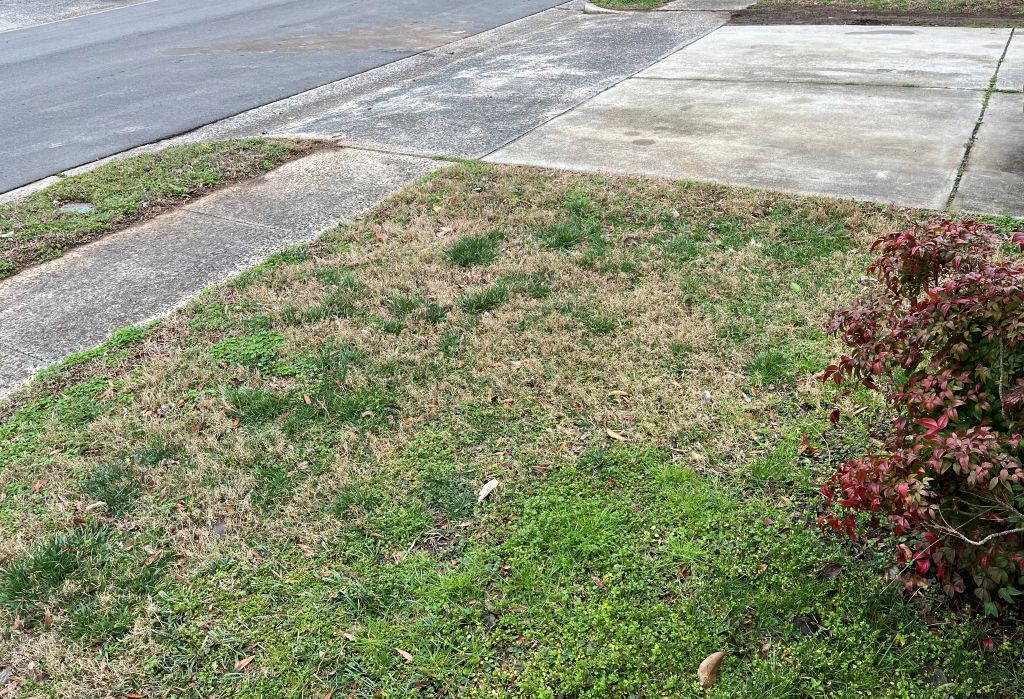
Every county in South Carolina is at least in a state of moderate drought. That hasn’t happened in almost 20 years.
Scott Morgan, Managing Editor
Feb. 28, 2026
As we enter March, and with the exception of parts of seven counties in Virginia, the entire Southeast is in a state of drought, according to the National Drought Mitigation Center at the University of Nebraska-Lincoln.
The map below was released on Feb 24, showing the severity – from Virginia to Florida and Alabama, almost all of the Southeast is classified as being in, at minimum, severe drought.
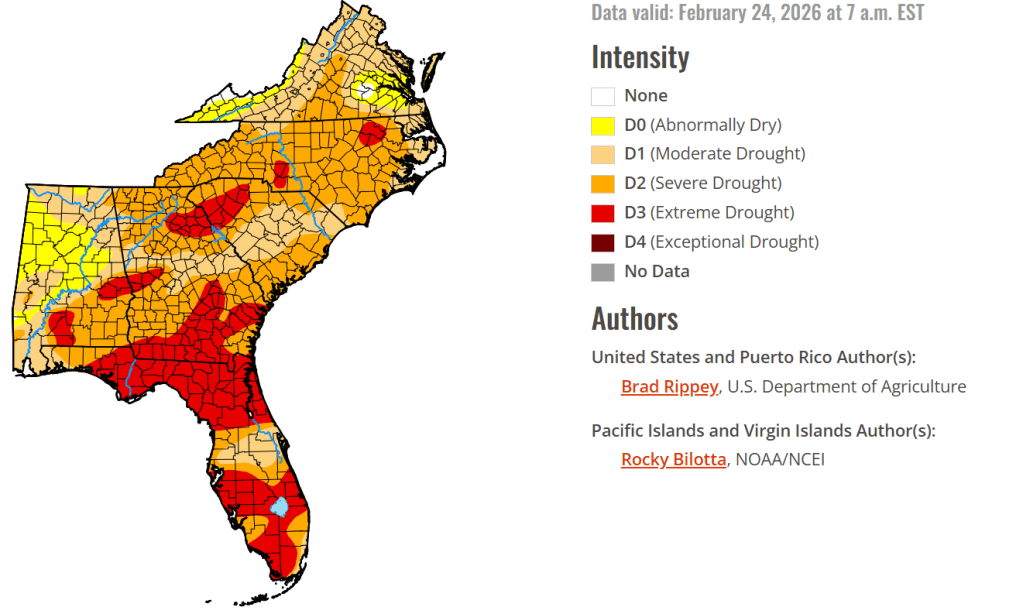
South Carolina is a mix of three drought conditions: moderate (drought status D1) in the center east-west third of the state, severe (D2) in the counties bordering North Carolina and in the coastal Low Country, and extreme (D3) in the western Upstate.
There are two other drought levels, D0 and D4. D0 is abnormally dry and D4 is exceptional drought. Nowhere in the Southeast was under a D4 classification at the end of February. Nowhere in South Carolina was under D0 or D4 status
However, the state of drought in the region, and in South Carolina is serious. According to NDMC, 90% of the Southeast is in at least D1 status. That has not happened in the center’s recorded history.
In fact, before January of this year, the last time the Southeast was even close to that number was in the late summer and fall of 2007.
On Feb. 26, NDMC reported that 100% of South Carolina was at least in a state of moderate drought, which also has not happened since 2007. The closest since then was in the spring of 2012, when more than 98% of the state was classified as at least D1.
Twelve counties, all in the Upstate, have areas under D3, extreme drought, status. Two counties, Abbeville and Laurens, are entirely under D3 status.
Under all the data, of course, is the threat of wildfire.
As of Feb 23, the South Carolina Forestry Commission reported eight active wildfires in the state, all of which were 100% contained. Those fires have burned 120 acres, the largest in Orangeburg County (D1), where 25 acres burned.
As of Feb. 28, there are no official burn bans in South Carolina. The last countywide ban was in Horry County, and it was lifted in January.
The current number of wildfires is not unusual for South Carolina. According to historical data from the state Forestry Commission, South Carolina sees between 1,000 and 2,000 fires, burning about 7,000 acres in a fairly typical year.
This winter in South Carolina, despite some atypical snowfall in the beginning of February, has been largely dry. Abbeville and Laurens, the two counties entirely under D3 status, have only seen rain on four days in February.
The National Weather Service predicts a moderate chance of rain in the Upstate over the next few week, which will not be enough to mitigate severe or extreme drought conditions.
 the Oasis
Leave a comment