
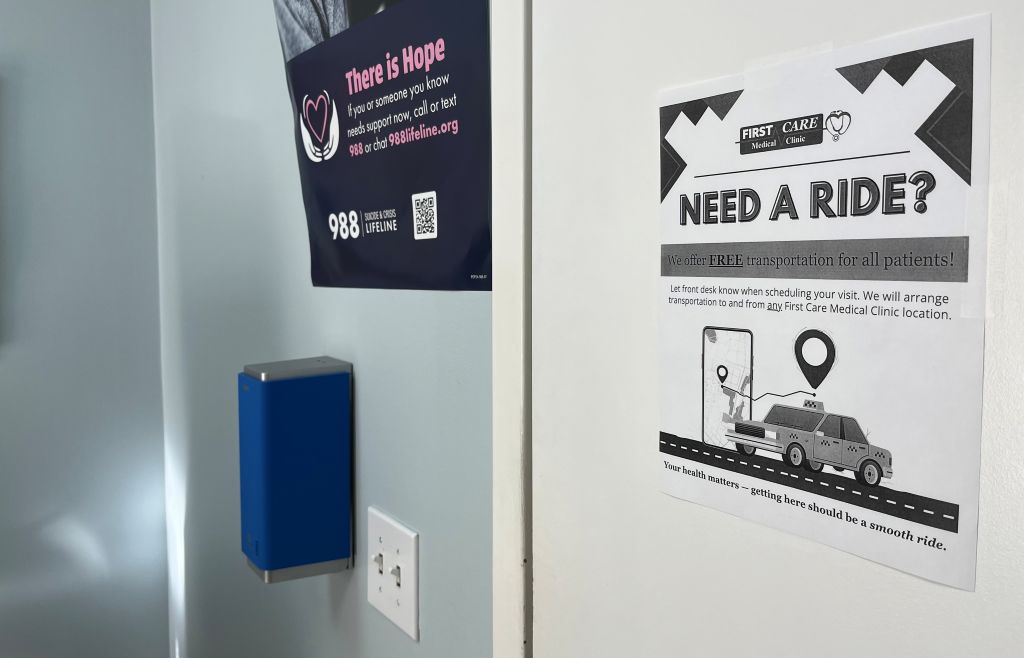
Mobility-impaired passengers face unreliable schedules, long rides, and drivers who sometimes just don’t pick them up for medical appointments (or much else). One medical clinic in the Charlotte area came up with a novel solution for its patients — pick up the passenger and the tab.
By Scott Morgan, Managing Editor
Nov. 14, 2025
Take a long look at the photo that sits on top of this story.
What does it say?
No. What does it actually say? Not the words themselves, the words behind the words. What do you think it says that this slice of printer paper is taped up to this particular door in this particular exam room in Rock Hill?
**
Whenever the subject of transportation among those with disabilities comes up, thoughts tend to turn to paratransit.
To qualify for paratransit services, a person must prove a level of disability. Cities with public transit systems, in return, must provide similar access for paratransit services.
And if “similar” sounds vague to you, then you have company.
“ Paratransit must be comparable to the fixed route, meaning it must run the same service days, hours, and basically the same service area,” says Cason Stark, transportation coordination manager at Able SC. “The only difference is, it goes three-fourths of a mile away from the fixed route.”.
Meaning: If someone doesn’t live within three-quarters of a mile from a public transit stop, the options for transportation for riders with disabilities reduce to family and friends or what Stark calls “non-emergency medical transportation” — i.e., rideshare.
Paratransit systems, like York County Access, YCA, provide rides only for what are considered to be essential services — medical appointments or life-sustaining shopping, or, if you live and work within Rock Hill city limits, rides to and from a job. Paratransit services are not rideshare services, like Uber or Lyft; they are public transit services that only serve clients for whom access to main public transit, like buses, would be difficult..
What we’re talking about is access
Take another look at the photo. Is the point of it coming into sharper view?
Because prevalence of medical care in and adjacent to York County is not a problem. There are plenty of doctors, plenty of hospitals.
The problem is access to medical care, even with a fixed-route bus that rides right up to a doctor’s front door.
“ One of the biggest barriers for transportation is infrastructure,” Stark says. “Most people [don’t] think about that. That could be no sidewalks, it can be no bus shelters. Some bus shelters have no seats, which I see a lot [in Columbia]. Or the bus stop is not assessable in general.”
And we’re not even talking about time.
“ I definitely hear a lot of complaints about … how the bus rides are long,” Stark says. “But it is gonna be the same way with paratransit because it’s supposed to be comparable to the fixed route. The fixed route is gonna take two hours to get you there. Paratransit is allowed to take up the two hours as well, because it’s not supposed to be ‘special treatment’ or anything. It is supposed to be equal to the fixed route.”
But equal is not always an equal word. Navigating transit as a person with a disability already puts riders in a different place.
To be clear, disability advocates and residents who have disabilities are not asking for special treatment. But they would like to be able to navigate their lives without having to schedule rides two days in advance or allot huge amounts of time to getting basic things — and often, only basic things — done.
Take J.
J is visually impaired and lives in Fort Mill. She has used YCA for rides to and from doctors’ offices. Like other YCA users I’ve spoken with, J says things don’t always go as planned — drivers have shown up far too early or too late, she says. And then there’s the frustration of trying to time things out within a paratransit schedule.
“For example, my bowling,” she says. “My bowling starts at one o’clock and ends about 3:30. The one o’clock is a bit dodgy for them because that’s usually when they have to pick up the senior citizens from dialysis, or whatever, and bring them home. The 3:30 is pretty much impossible for them because that’s their busy time.”
J says that YCA has never given her any trouble about taking her to bowling or any other “fun activity,” even though the YCA website spells out that rides are intended for essential trips, and even though rides can be hard to schedule conveniently.
But J, as do other YCA users, say that they see social activities as essential to their overall emotional health.
Representatives from the York County Council On Aging, which operates YCA, were not available for an interview before this story published.
J concedes that YCA is small and has limited staff. She also gets that she’s not the only person the service transports. And, in a later phone call, J said that YCA has offered her free rides through ymonth’s end, after she had filed a complaint.
But for J, being in Fort Mill means YCA drivers — many of whom operate out of Rock Hill, 20 minutes down I-77 — have to get to her, and, usually, take her back to Rock Hill for her appointments.
J has partially given up trying to make it work with YCA. She’s turned to paying for car service, sometimes a rideshare, sometimes a taxi service. One gentleman ran his own car service, and she liked him a lot.
“ He was early to pick me up,” J says. “Always had the drink of my choice in the car waiting for me; allowed me to choose the radio station that I wanted to listen to.”
But he wasn’t cheap.
“He would work with me,” she says. “Like, if it was $40 round trip to get to Rock Hill, he would do it for $35 round trip.”
Uber and Lyft are comparable rates.
Quick math: At $35 per trip, it would take six trips to break the $200 mark. And $200 is about what the average American pends on gasoline per month, according to a study by JD Power & Assoc. J spends about $300 per month on transit. That same JD Power report puts monthly transportation costs overall at about $1,100 for the average American. But J, like many people with disabilities, lives on a tight, small, fixed income, for which $5 can be a big deal.
“ I know $5 doesn’t seem like a lot, round trip,” she says. “But that kind of adds up, to spend a lot of money to get to where access is located.”
Where access is located
Until 2019, the City of Rock Hill had no public transit system. City leaders then decided to invest in an all-electric bus fleet to serve the most in-need neighborhoods. It also operated its own paratransit fleet.
By 2024, the electric bus fleet had dwindled from ten to two, as the company Rock Hill had contracted through, Proterra, had gone bankrupt. And paratransit operations had been shifted to York County.
With the highest concentration of people and services in York County, Rock hill is where the easiest access is located.
J is looking to move to Rock Hill next spring. Not just because her doctors are there, but also because there’s recreation, like he bowling league. She relies on her bowling league for a social outing, something she’s hard-pressed to find in Fort Mill
But living in Rock Hill doesn’t guarantee a smooth experience.
“I’m not on my own, but I kinda am,” is how Pauline, a city resident who used to be able to catch a nearby bus, puts it.
Pauline contends with epilepsy and osteoarthritis, conditions that render her unable to drive. When Rock Hill’s MyRide bus system was in full force, there was a stop not far from Pauline’s door that she could easily walk to. But when the bus fleet started to erode — Proterra’s bankruptcy left the city with vehicles it can’t replace or repair, because the proprietary technology inside the vehicles is no longer available or is difficult to obtain — so did the stops. The stop by Pauline’s apartment was pulled from service, leaving her to rely on friends who aren’t always around, or YCA, which she says is not reliable.
Pauline has shared multiple exchanges that she’s had with YCA, which she says often misschedules her pickups.
She doesn’t blame the drivers, and she finds the YCA staff pleasant. But she also says that those who schedule her rides often get things wrong, leaving her to try to figure out who can pick her up.
Moreover, she says, she wishes it were just easy for her to “get up and go,” to wherever. Remember, a paratransit ride generally demands the rider go to work, medical appointments, or life-sustaining shopping. There’s nothing about fall festivals or concerts, Pauline says. And leaving her to figure out how to get to social activities, especially after service hours expire, has the effect of making her feel as if her access to life is just not what it would be were she able to drive — which, until only a couple years ago, she could do.
“I’ve stepped off Facebook,” she says. The Facebook Memories that came up on her account started to get depressing.
“I’ve seen where I used to be out with my friends,” she says. “Really, it’s just frustrating.”
When rideshare is not a solution
Take money out of the equation for a second. Let’s say it’s not a hardship to pay for an Uber or Lyft ride. Riders with disabilities still have to contend with the fact that rideshare drivers will often pass them up, says Larry Wanger, Able SC’s vice president and chief advocacy & independent living officer.
“It’s an issue for folks who use guide dogs or service dogs,” Wanger says. He has a guide dog himself. “It’s very frequent that they get passed up, file a complaint, and nothing happens.”
The same thing happens with riders who use wheelchairs, he says.
“ Because quite frankly there are no accessible Uber or Lyft vehicles pretty much to be had in this state presently,” Wanger says.
Representatives from Uber and Lyft did not respond to requests for interviews for this story.
There are some accessible rideshare vehicles in South Carolina, but they are hard to find, especially in rural areas. Charleston’s CARTA system (Charleston Area Rapid Transit Authority) has a partnership with Uber and Lyft to provide paratransit rides, as a way to augment CARTA service. Riders in need of a wheelchair-accessible vehicle can request one, but Wanger says there still are “some inherent issues” with the service, including a basic lack of vehicles equipped to take a wheelchair.
Abut even if things did go well in urban areas like Charleston, rural South Carolina is a different story, says Sandy Jordan, vice president and chief community integration officer at Able SC.
“Some big cities have the option to request accessible vehicles,” Jordan says, “but if the Uber drivers themselves have not noted that their vehicle is accessible, then the option is not there. We don’t really have those options here in South Carolina, and especially rural South Carolina. Uber and Lyft doesn’t even really exist in those areas, much less you’re thinking about an accessible Uber or Lyft.”
***
In September, the U.S. Department of Justice sued Uber over concerns that drivers pass up riders with wheelchairs and service dogs. The lawsuit seeks $125 million for “individuals who have been subject to discrimination and previously submitted complaints to Uber or the Department,” according to a DOJ statement.
The suit alleges “that Uber and its drivers routinely refuse to serve individuals with disabilities; impose impermissible surcharges by charging cleaning fees for service animal shedding and cancellation fees to riders whom Uber has unlawfully denied service; and refuse to reasonably modify Uber’s policies, practices, or procedures, where necessary, to avoid discriminating against riders with disabilities, including by denying individuals with mobility disabilities the option to sit in the front seat when needed. Due to Uber’s ride denials, individuals with disabilities have experienced significant delays, missed appointments, and have been left stranded in inclement weather.”
When rideshare is a solution
Full disclosure, I am a patient at First Care Medical Clinic, which is how I learned about the free rides mentioned on the sign in the picture above. I have received no benefit of any kind, and would accept no benefit offered, regarding this story.
So let’s go back to the photo at the top of this page, knowing now that many mobility-impaired passengers have, at best, sporadic luck with official paratransit services and, at worst, are refused service by rideshare companies if those passengers require accommodations for a wheelchair or service animal.
Such passengers can have a lot of trouble getting to the main destination paratransit is supposed to serve — medical appointments, says Obi Okwara, president of First Care Medical Clinic.
First Care operates seven medical clinics in the Charlotte area, with one in Rock Hill. Okwara’s father, Dr. Benedict Okwara, founded First Care and started noticing that patients were sitting in the waiting room long after their appointments.
“Or, they would come very early,” Okwara says. Either way, they would be there for a long time, because they didn’t have rides ready.
Moreover, Okwara says, patients weren’t coming to appointments at all.
“They would say, ‘I can’t come because I don’t have transportation,’” he says. “So we decided to eliminate [lack of transportation] as a reason for anyone to miss an appointment.”
First Care’s solution?
“We just pay for the Uber,” Okwara says.
First Care will pay a rideshare service to transport patients to and from any of its clinics at no cost to the passenger. For passengers in need of wheelchair or service animal-accessible vehicles, Okwara says the company will either contract with a paratransit service or ensure that a rideshare vehicle is equipped to handle such needs.
He says First Care had considered designing a fleet for patient transport, but realized quickly that it logistically made little sense to build and maintain a fleet of vehicles and a stable of drivers. Using an existing transportation system, with attention paid to mobility-insecure patients, just made more sense, Okwara says.
“The cost s marginal for us,” he says. “We’re not losing money on this. We want people to get care.”
Correction: Text was changed to show that J did not get free rides through the end of the year, she got them through November.
Like the Oasis? Want to stay up with stories about your neighbors in South Carolina? Start by subscribing to our newsletter. It’s easy. Just scroll down and enter your email address, and get notified when new stories are published.


 the Oasis
Leave a reply to mccolloughp Cancel reply